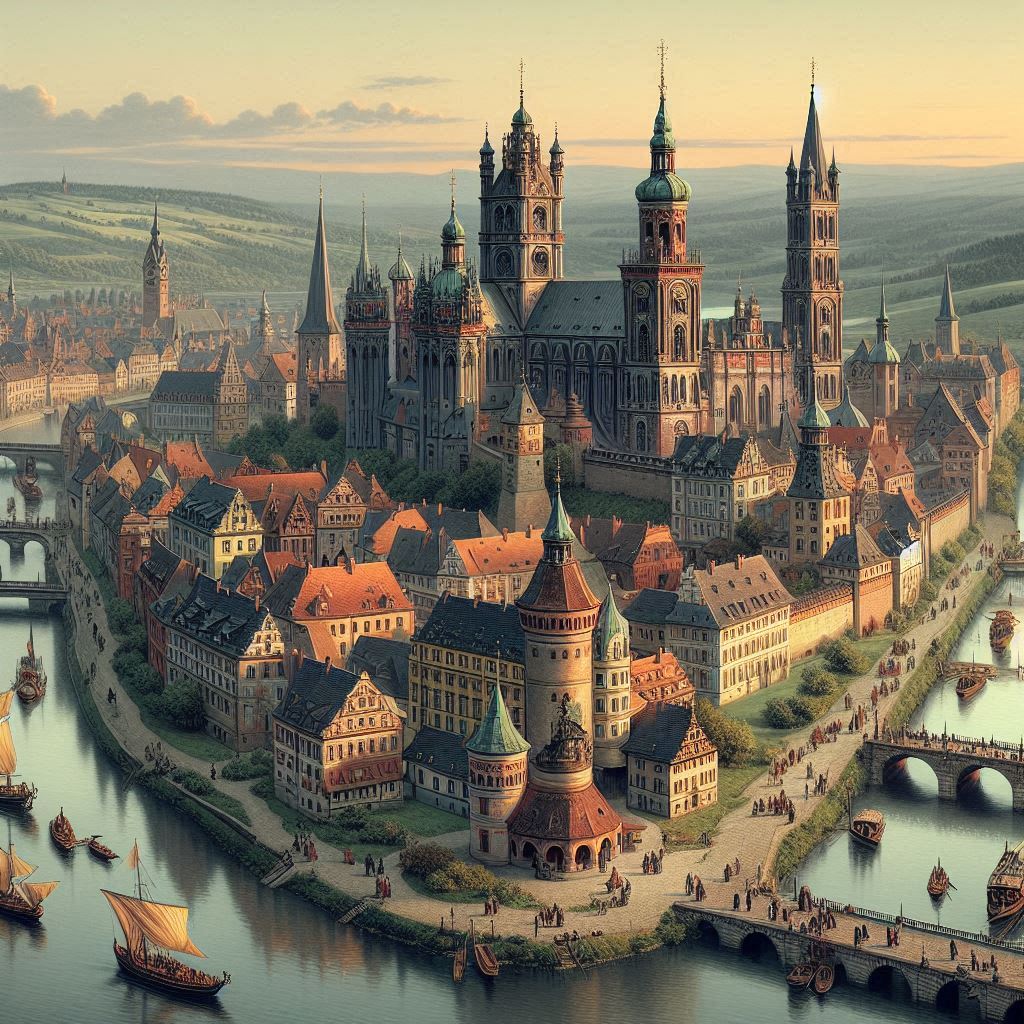
“With your valleys, bridges, forests, Always a splendid sight; The beautiful pure colors In the glorious golden sunshine.” – anthem of Posen-West Prussia
The Crossroads of German and Polish Heritage
Much like the valleys, bridges, and forests immortalized in the Anthem of Posen-West Prussia, the province itself was shaped by the intersection of Polish and German traditions, each flowing into the other like rivers carving their way through the land. Once a vital region within the Kingdom of Prussia, Posen stood as a gateway between two worlds, where cultures converged and histories intertwined.
From its days under Prussian rule to its eventual transition into Poland, Posen’s legacy remains deeply ingrained in European history. The region saw centuries of transformation, marked by administrative reforms, migration, and evolving national identities. Today, the historical echoes of Posen continue to resonate in its cities and villages, offering a rich tapestry for those seeking to explore their ancestral roots.
Medieval Foundations
Posen (now Poznań, Poland) was one of the earliest centers of Polish statehood, dating back to the 10th century. It was a key stronghold of the Piast dynasty, serving as a political and religious hub. The city became home to Poland’s first cathedral, built in 968, marking its significance in the spread of Christianity.
Throughout the Middle Ages, Posen remained an important trade center, benefiting from its location along the Warta River. German settlers arrived during the Ostsiedlung, a medieval migration movement that brought German merchants, craftsmen, and farmers to Polish territories.
The Polish-Lithuanian Commonwealth Era
By the 16th century, Posen was firmly integrated into the Polish-Lithuanian Commonwealth, a vast and influential state. The city thrived as a center of commerce, education, and governance, attracting scholars and traders from across Europe.
During this period, Posen saw the rise of Protestantism, particularly among German-speaking residents, while Polish nobles and peasants remained predominantly Catholic. Religious diversity shaped the region’s cultural landscape, with churches, synagogues, and Protestant congregations coexisting.
Wars and Shifting Borders
The 17th and 18th centuries were marked by wars that devastated Posen. The Swedish Deluge (1655-1660) brought destruction as Swedish forces occupied the city, leading to economic decline. Later, the Great Northern War (1700-1721) and conflicts with Prussia and Austria further destabilized the region.
By the late 18th century, Posen’s fate changed dramatically with the Partitions of Poland (1772-1795). In 1793, Prussia annexed Posen during the Second Partition, integrating it into the Kingdom of Prussia. This marked the beginning of German administration, setting the stage for the province’s transformation in the 19th century.
Transformation Under Prussian Rule
Under Prussian governance, the province underwent industrialization and infrastructure improvements, including the expansion of railways and urban planning. Despite these advancements, tensions between Polish and German residents persisted. By the late 19th century, Prussia intensified its efforts to assimilate the Polish population, leading to significant social and political struggles.
The Fate of Posen After World War I
Following World War I, the Treaty of Versailles (1919) transferred most of Posen to the newly formed Second Polish Republic, marking the end of Prussian rule. Some areas remained German territory as Posen-West Prussia until 1938, reflecting the shifting geopolitical landscape of Central Europe.
Legacy and Historical Significance
Though Posen, Prussia, no longer exists on maps, its valleys, bridges, and forests endure, bearing witness to a remarkable history of resilience, transition, and unity. Its legacy lives on in architecture, archives, and the memories of those who trace their roots there.
Explore more in this detailed guide on uncovering family roots in the region.
 OFB index